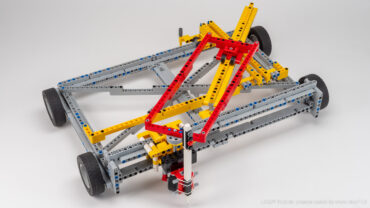
LEGO Technic replica of an Integraph, a mathematics instrument created in 19th century by Abdank-Abakanowicz, for plotting the integral of a graphically defined function. Designed in 2011, finally with instructions !
How it works
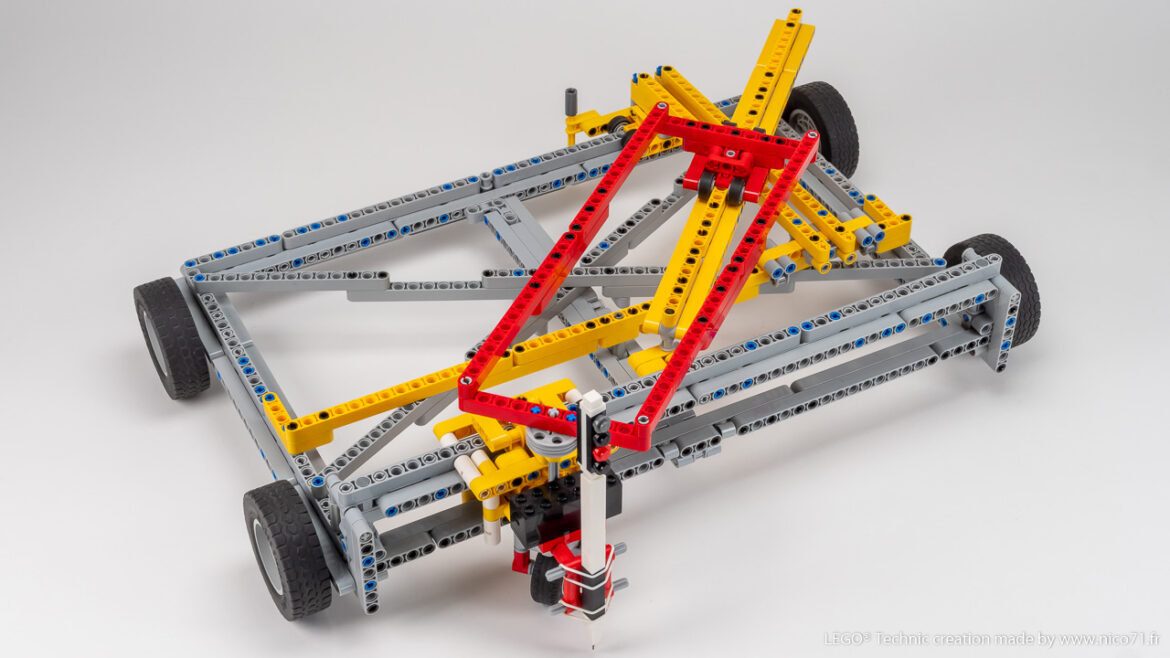
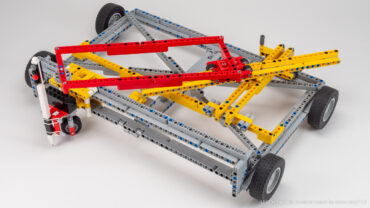
The grey chassis with wheels move in x axis, the input stylus along the y axis. The stylus is placed on a sliding sub chassis with a slot. On this slot come the carrier which is connected to the main orientation arm, so when the stylus move, the orientation of this main arm change.
On this main arm, there is a sliding mechanism which hold the red carrier. This red carrier is build in a parallelogram way, in order the orientation of the two beams remains parallel. And on the extremity of this red device, the rotating beam is connected the contact wheel. So when the stylus input moves, the main arm rotates, and the orientation of this main arm is transferred to the contact wheel. The contact wheel is mounted on a carrier which can freely slide left right in y axis, and hold also the pencil with rubber band, plotting the output graph.

The trick is that the contact wheel acts as a tangent wheel where its orientation will defined where it goes by acting on the carrier, being free of moving on the chassis. When the tangent wheel is aligned with y axis, the carrier does not move. When it is angled, the tangent wheel forces to displace laterally the carrier, and as its orientation depends of the y value, it moved along the differential curve and plotting the output graph.
But why its integrate ? Because by definition, the inclination of the tangent of the integral curve -the slope or gradient- is equal to the ordinate of the initial curve to integrate (differential curve). If you look the machine in the reverse order, and follow a curve using the tangent wheel, the orientation of the tangent wheel define the gradient of the curve and so its derivative on each point which is the Y value.

All the mechanical complication around are just to transform translation into rotation movement, and decouple each movement to be independent and not dependent of their position with the different slide and carrier.
The applications of the integraph was numerous, calculate or divide areas, determine centres of gravity, calculate moments of inertia or stability, load and resistance, and solve algebrical equations like simple differential equation. Compared to a planimeter which gives the area result under the curve, the integraph give the representation of the function (primitive) so further calculus can be done. Therefore it was use in applied mathematics and physics, civil engineering with earth transport and bridge design, electricity with electromagnetism, shipbuilding, irons constructions, optics and ballistics with displacement and velocity determination for instance.

These types of machines reached their peak with the mechanical differential analyser and balistic calculator in the twentieth century and then decreased in popularity with the advent of the computer.

Compare to the original Integraph design in 2011, I mainly rework the different carriers to minimize the friction and have a better bracing. I used for that rotating pin joiner, rubber wheel and frictionless tile. The tangent wheel has been changed too for a design which follows more accurately the curve, using a new holder and new wheel. The chassis has been slighly improved to enhance the rigidity and part usage. The parralelogram can be easy dismantled to set up easily the integraph and accomodate the weight replacement.
Some additional resource :
- Animated Diagram Online and Displacement simulation (youtube)
- Wikipedia Page
- Mathsinstruments page about an integraph
- Bruno Abdank-Abakanowicz books from 1886 (author, chap 3. french)
- Integraph Page on Drawing Machine
Video
How to build ?
📕 You only need the parts and the instructions. You can purchase the PDF instructions on the shop and build with your own parts.
Maths Instrument : Integraph
🎁 If you want to purchase the parts + PDF instructions, have a look to the official retailers :
- Using LEGO Genuine Parts : request a custom quote from them
- Using Alternativee Chinese Parts : available at lesDIY Store
🧩 The bill of material can be checked below in the instructions previews or on Rebrickable.


For the model, I used a quite rare boat weight ref 73090. You can replace by any heavy part of about 50gr or use the alternate LEGO weight setup below (based on this part, instructions included in the purchase).

How to it
- Fix the paper, ideally A3 for both input and output, on the support with tape
- Place the integraph parallel to x axis, and the stylus on the smaller value in y.
- Place the tangent wheel carrier on the middle of its travel.
- Displace the integraph along the x value (horizontal left to right) while following the curve with the stylus (vertical y value)
- You can help the yellow sub chassis to move, as wheel as the tangent wheel carrier if it get stuck
- It is easier to be two to operate the machine (on for the x axis by holding the wheeled chassis traight, one for the y axis to follow the curve with the stylus)
- Ensure the surface is plane and the pencil touch it without too much force (do not lift the tangent wheel)
- If a part of the curve is missing, you can draw by hand if you have integrated a continuous functions