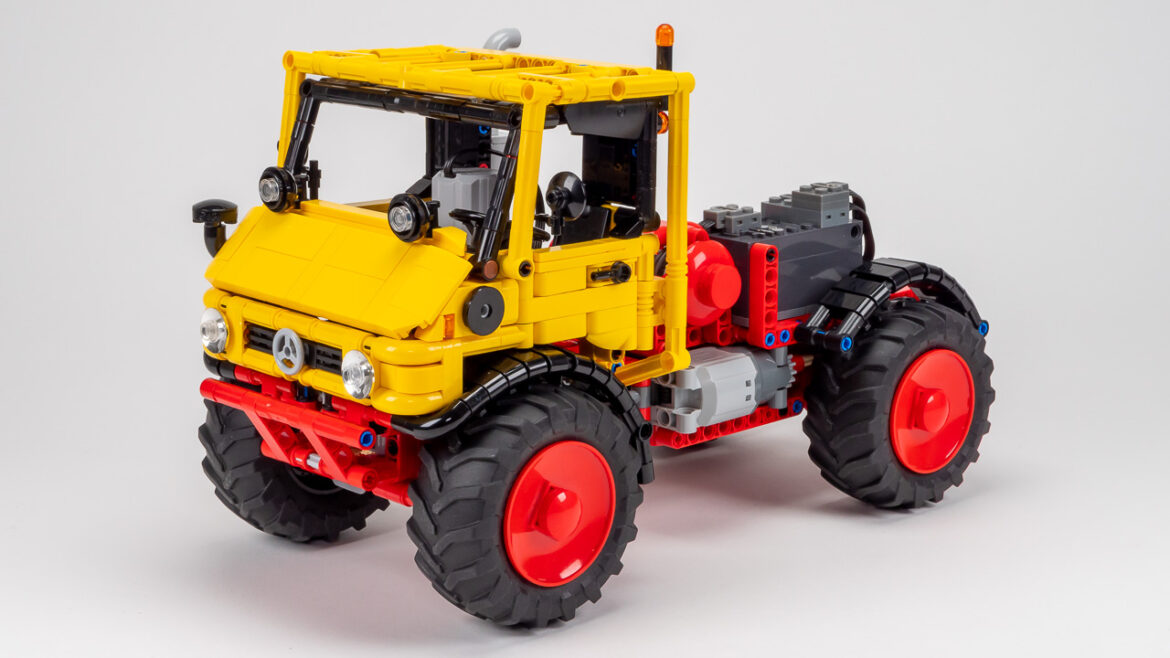
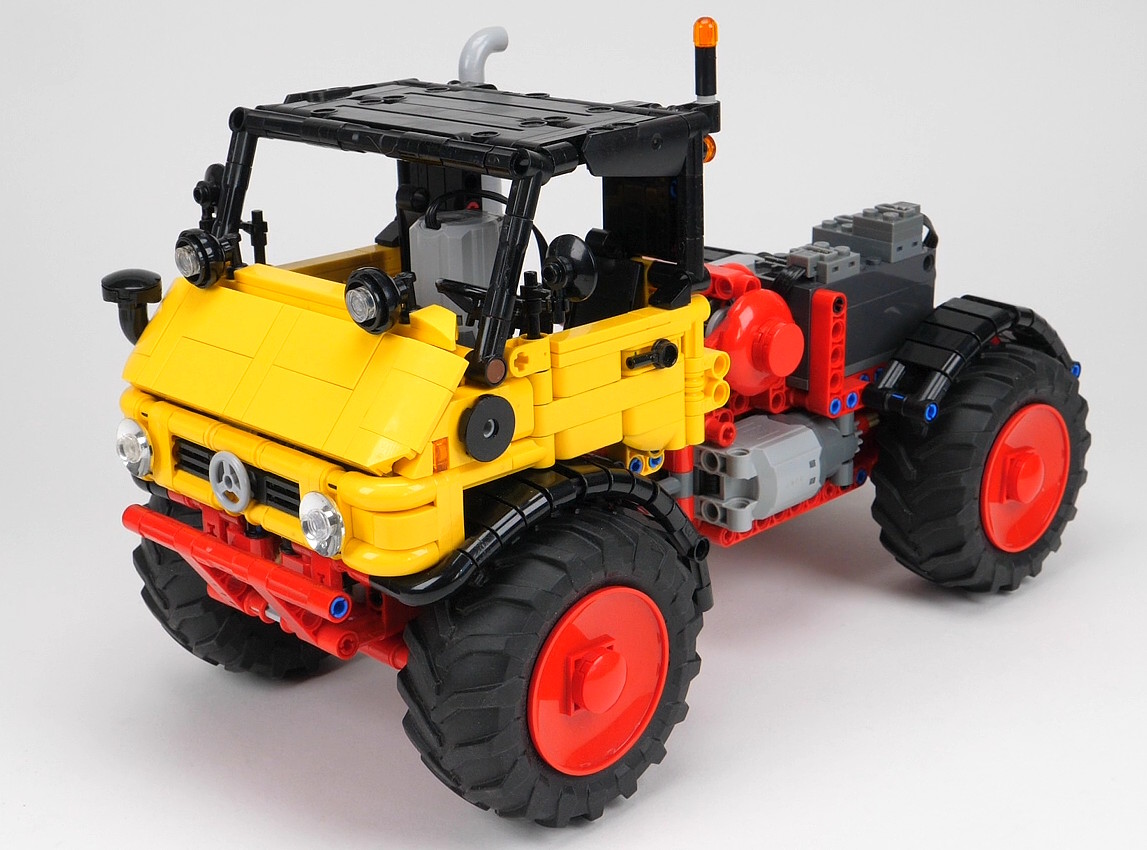
A 1:15 LEGO replica of the Werner Uniknick, an unimog based articulated forestry truck from 70’s. Features 4×4 transmission, articulated steering with linear actuators, winch, fake engine and openable elements, built for the mid scale truck trial competition for the 2025 Buwizz Gathering.
This article is a transcript of the Design Secrets Video on YouTube (10 min)
Context
This is a LEGO Technic replica, measuring 30 centimeter long for a scale of 1/15 (feels bigger isn’t it ? This is due to the massive wheel. To compare a 1/15 car is 43mm wheel, here is 81mm). It was built for the 2025 Buwizz Trial truck competition, which took place in Slovenia where the diameter of the wheels was specified to heighly one milimeter. I had for a while this model to build on my todolist so I motivate myself to do it and compet.

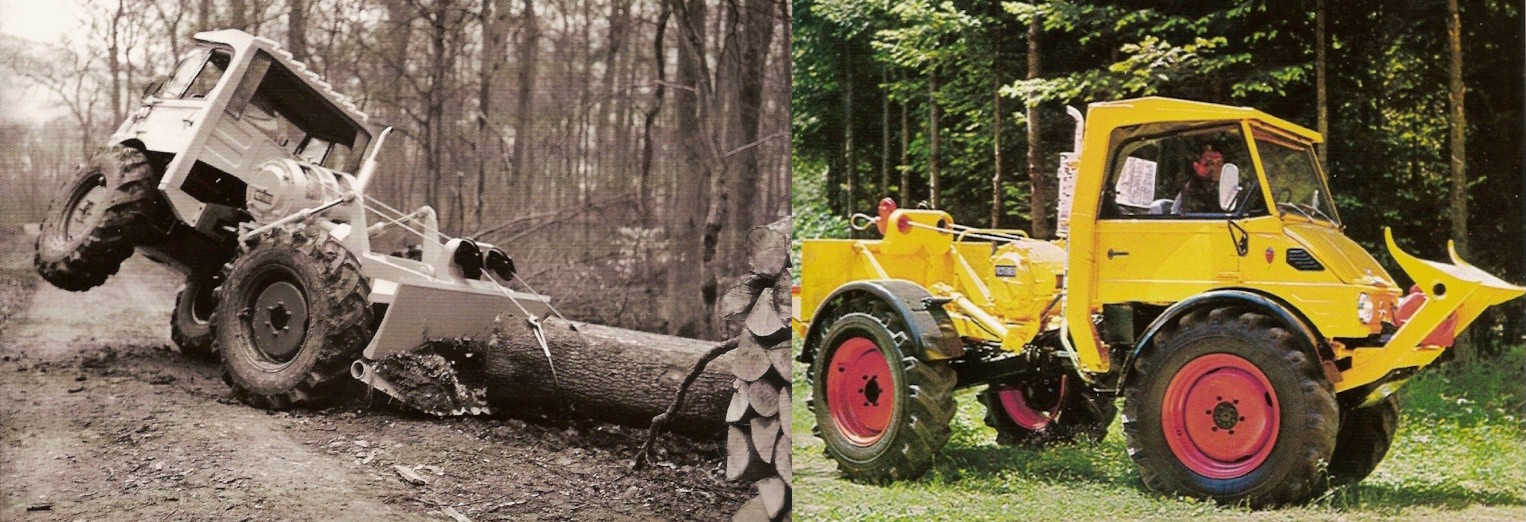
But why this model is special, because the original model is. Werner is a forestry equipment manufacturer moslty know for their vehicule modifications, based on unimog and MB trac. In the seventies, they developed an articulated skidder, based on Unimog 421, axles and cabin, while building the central articulation, and the forestry equipment such as the skidding blade, winch, and massive tractor wheels. They even lately developed and second version which looks more a skidder, again with Unimog parts.
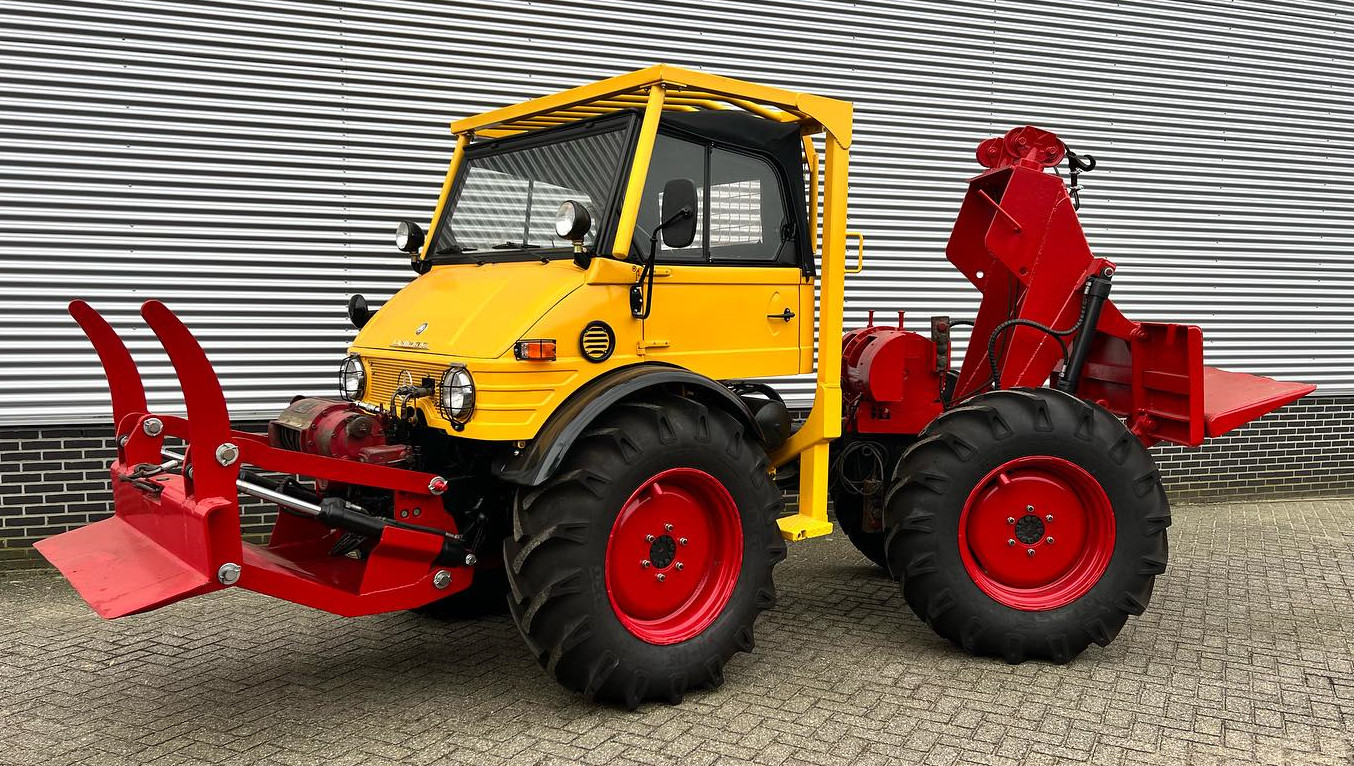
About the LEGO version, it reproduced the UK60, with 4 inline fake engine, torpedo small cab with cabin protection, without tools but with its lovely red and yellow livery.
Functions
The model is motorized with power functions system and a buwizz, but you can replace the buwizz by other controller such as Cada or Mouldking. It is not possible to use Control+ motor without modifying the chassis and so the wheelbase. The drive is made using 2 L motor which drives 16 tooth gears to the central driveshaft, which power the differentials. Then the movement is transmitted to the portal axle, made with 8 and 24 tooth gear. The differential can be swap with bigger gear ratio with the red crown or the equivalent without as I did on the Buwizz Events to maximize traction over maneuverability.
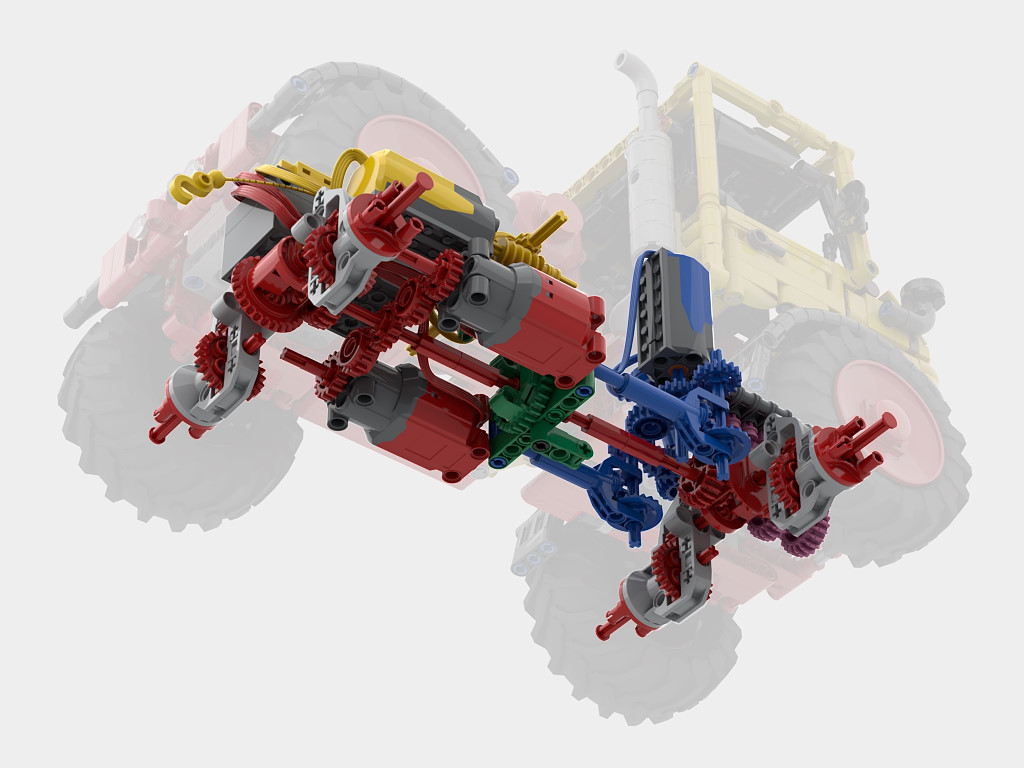
A small trick for the portal hub. I used this assembly composed of thin 2 L liftarm and axle, which prevents the axle to pop out with torque, as it is only attached on the other side in the differential so, by a small bevel gear. The portal hub enables to increase the ground clearance but also reduce the needed torque on the central driveshaft to relieve the tension on the universal join. Especially here as the driveshaft crosses the central articulation. So, when the model is stuck and the motors force at full torque, the tipping torque tend to rotate the central articulation and so the chassis rotate which can lead to a tipping over. So less torque on the driveshaft is better for the axle wrap. As usual, it is better to concentrate the gear reduction near the wheels with spur gears if possible as it reduce the torque on previous elements like Universal join or bevel gearing.
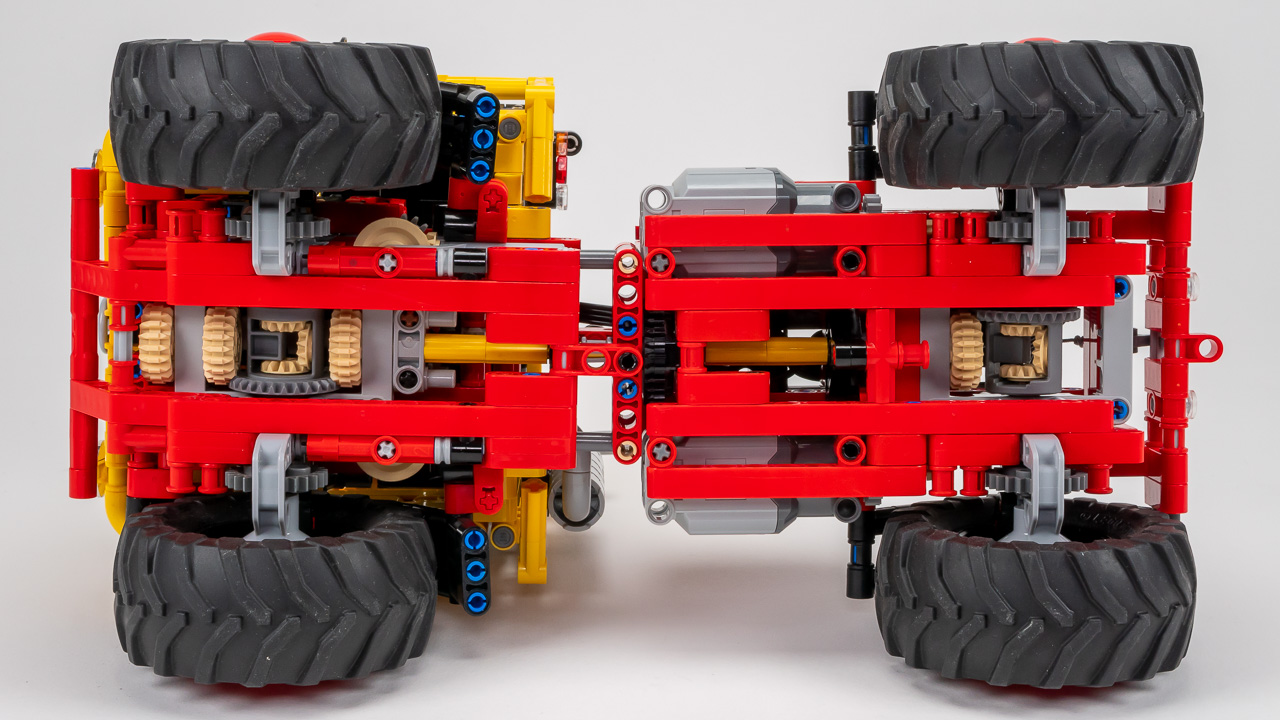
On the front of the model, the central driveshaft drives the fake engine using spur gear too. It enables to disconnect and remove it easily.For the build, it is inspired by the solution used on my Nissan Skyline where I release free instructions for the engine collection by the way.

Steering
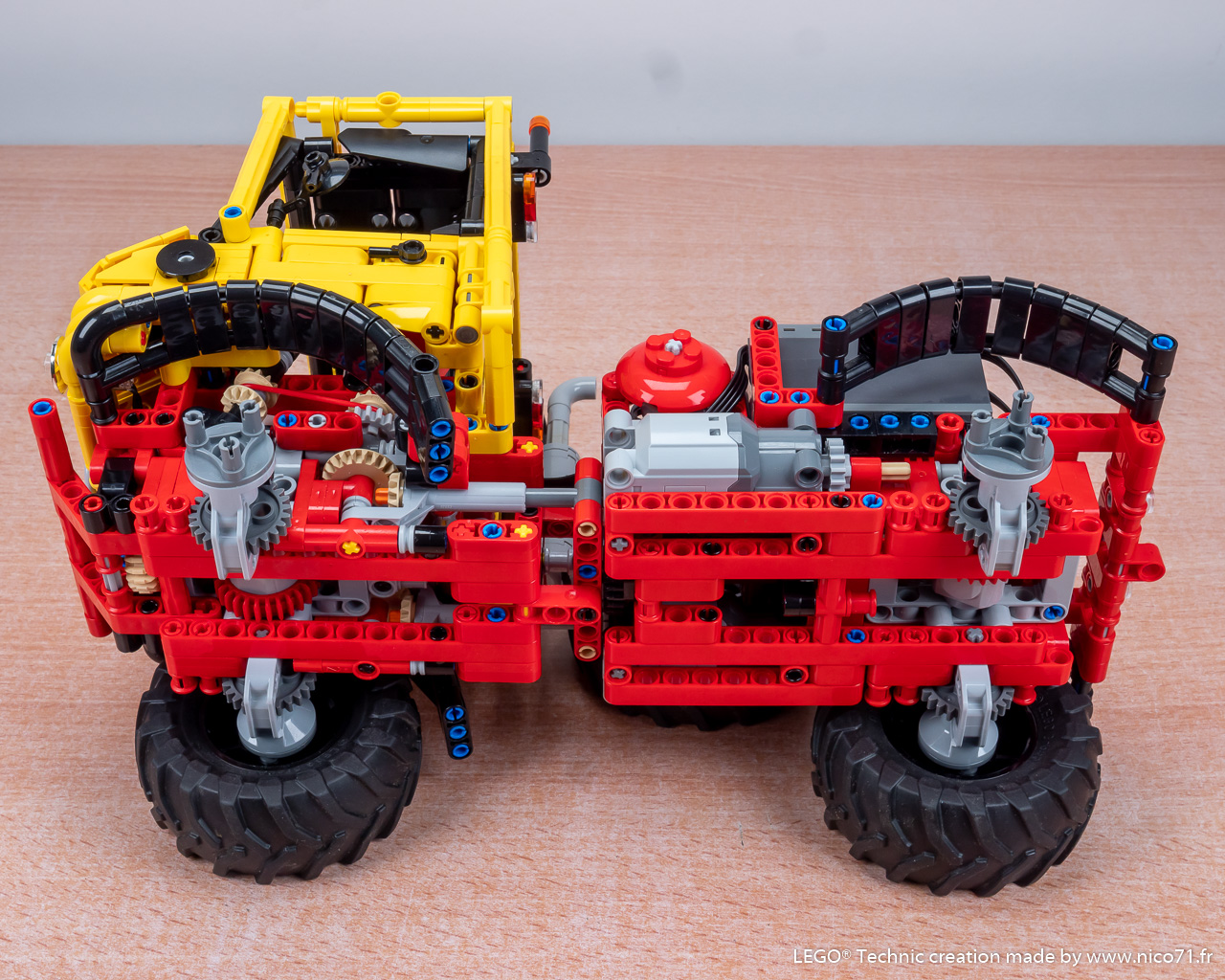
It is driven by a L motor placed in the cabin, which drive spur gears to split the movement on both sides which power linear actuators. The end stop clutches are made using the internal clutch from the linear actuators which work fine but I hate this sound. The difficulty here was the half stud offset. Indeed, to maximize the steering angle, I had to use the full travel of the linear actuator, which is 5 studs, so the center had to be positioned at 2.5 studs on the chassis, off the grid.

For that, this time, I did not use half stud connector, but thin liftarm on the axle extension of the portal hub. And on the chassis, this assembly with regular connectors and half bush on pins. Consequently, you can see that the spur gearing is off-grid from underneath with the center and outer axle not being aligned, which do not cause any problem of functioning as long as the axles are braced correctly.
You can see here that I use a small bar to secure the top bearing, as a regular axle will touch the gear. I also use red idler gears whenever possible to reduce the friction in case of misalignement especially under load.

The return to the steering was a bit complicated to do. At first, I just connected the left linear actuator to the steering column using a rubber band. But the speed and the angle make it pop out sometime. So I reworked it with gearing, which gives me the opportunity to decrease a bit the speed of the steering wheel, still too fast with 8 (eight) turns instead of 5 (five) from left to right.
Suspensions
As you see, the model do not have regular springs on the axles, as on the unimog. The axles are bolt on the chassis and the axle articulation is made on the central articulation. This is a pretty common setup in forestry vehicle as it makes the chassis aligned with the wheels for the work with tools and enables bigger wheel with lower center of gravity, but come with some drawbacks. The ground clearance is usually lower but more importantly, the axle articulation must be controlled, especially here as the driveshaft cross the central articulation as discussed before.

Indeed, during the axle articulation (from ground or from tipping torque), the weight of the cabin is pushed away from the center so it is more sensible in side slope. The weight as to be concentrated in the chassis as lower as possible and the axle articulation limited in angle. On my model, the axle articulation is made with a small turntable, mounted after the steering plate. As the turntable has some play, I added a link on the top, which act as a reinforcement to prevent the joint to collapse too much, but also as a angle limiter. As the length of the rod is fixed, and the mounting point higher than the central articulation, it will naturally block the articulation at a certain angle.
For the weight, I tried to minimize the cab weight as possible and placed the motors in the chassis when I could. The buwizz is placed on the back to compensate the weight of the cab. With this setup, the maximum side slope is about 45° (forty five degrees) but very sensible for axle wrapping.

Winch
It is powered by a M motor, which drives a worm gear over 8 (height) tooth gear to get low speed, high torque and irreversibility, even if the worm gear loose easily half of the power in friction. It is more decorative than very effective in trial truck competition. As the speed is low, it usually takes too much time to unwind, attach, wind, detach, than taking a replacement penalty.

Manual Version
To finish with the functions, a word about the manual version. On request, I have designed a manual version of it, after the release of the motorized version. So I simply removed the drive and steering motor, and placed a hand of god instead. It was the easiest solution as I wanted the model was upgradable from both version, so you can build the manual version, and add motors later without adding spare parts or rebuilding the whole model.

The steering is consequently a bit slow but still playable or for display at a cheaper cost. The biggest change was on the winch, which is now equipped with a ratchet with two positions, one to unwind easily, and one to lock when the drum is wound by the side. The manual version is included with the motorized version in a single package, as it share 98% (ninety eight percent) of the partlist.
Bodywork
Let’s talk about the bodywork, not the most important thing in a trial truck but I wanted it looks nice. First, obviously, the color scheme is gorgeous with yellow cab and red chassis, it contributes a lot of the visual identity of the model. The cabin was not easy to do, because the unimog cab has round front side and curved hood.

For the front, I used a combination of axle joiners and macaroni tubes for the side. I hesitated for a long time to stack three of them but I thought it didn’t look great. So I tried with curved bricks, but the radius was not good. So I came up with this hybrid solution with two macaroni tube and one curved brick which gave the correct shape with a bit of texture.
For the hood, it is massively composed of curved tiles to get the proper shape, and is fixed with angle on the cabin with small beams. It can be opened but not that much so easier to remove by removing the two axles with stops. The additional lights are usually attached on the side of the windscreen but here I found it bulky so I fixed it internally on the hood on an angled tile assembly.
The angle of the side underneath the hood was also tricky to find as it has to fill the gap correctly to look nice. So I came up with a solution using a slope with the cheese slope and the transparent orange blinker between, without pushing it to the max. Do you say illegal ? Yeah maybe.. The last noticeable elements are the mudguards, composed of soft axles with 3 L beams. In fact, I used this solution for the first time on my LMP1 designed in… 2015, then reused on several Citroen cars.
And to finish, here is what it looks like without the tubular protection on the cabin, looks nice ! I think I will modify and reuse the cab to make a proper unimog with a new chassis, so if you like unimog, stay tuned !
Conclusion
If you are interested by the model, instructions, or available kits, please go to the shop :
Werner Uniknick
I hope you liked this model ! It was very interesting to make, even if it was beaten by more classic and powerful models. It was a good challenge to offer something different at the Buwizz Gathering 2025 with articulated trucks, and for sure, I’ll come back this year ! (spoiler, I come back in 2026 with a regular 6×6 heavy truck inspired by Berliet GPO and did a better ranking !)